

The Virgin and Child Enthroned

about 1475-85 · Oil on wood
Dimensions 121.9 x 82.6 cm
Collection: National Gallery, London
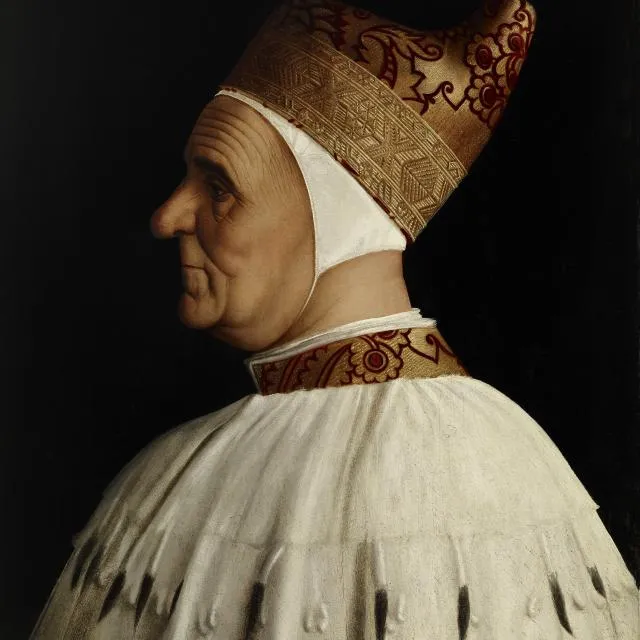
This is one of only two surviving images of the Virgin Mary and Christ Child by Gentile Bellini. Its large size suggests that it was probably the central panel of a large polyptych. It has been connected with the apparently now-lost altarpiece that we know Gentile made for the Scuola dei Merciai (the confraternity of the merchants) in Venice.Gentile tailored the image to Venice and to his mercantile patrons, many of whom must have been involved in the city’s thriving trade in luxury textiles. The Virgin’s mantle is painted to resemble velvet woven onto cloth of gold in an elaborate pomegranate pattern. This originally Ottoman design (as worn by Doge Leonardo Loredan) was hugely popular for luxury fabrics in Italy. It was adopted by Italian weavers who in turn exported it to the eastern Mediterranean.The marble steps are covered with an oriental rug that resembles a prayer mat used by Muslims. The rug includes a triangular niche, a reference to the mihrab found in mosques which indicates the direction of Mecca, the most holy site in Islam. Rugs like this date from around the mid-fifteenth century and were popular in Italy as exotic luxury items: one is recorded in the possessions of the Duke of Mantua in 1483. These precious textiles were used for display, not walked upon, and so its position under the Virgin’s feet is a sign of her majesty as well as an indication of the reverence due to her.The coloured marble and porphyry (a purple stone) of the backdrop of the throne reflect many religious buildings in Venice, such as the church of San Marco and the church of Santa Maria dei Miracoli (which was being built at around the time that Gentile painted this picture). The use of this kind of stone in Venice, however, ultimately derived from the architecture of ancient Rome and Byzantium, stressing the Venetian links with the Byzantine world. The design of the throne may also be inspired by a stone seat in the church of San Pietro di Castello in Venice. Originally an Islamic funerary monument, it was later reworked and thought to be Saint Peter’s throne. Since it came originally from Antioch in Asia Minor, Gentile may have included it as another example of Venice’s links with the lands of the eastern Mediterranean.Gentile’s signature appears in the form of an inscription on the base of the steps. He has added his title, Veneti Equitis (‘Knight of Venice’), after his name – a detail that emphasises his status among his fellow citizens. The artist was knighted for the first time in 1469, so this work must have been made after that date.
57 collected·51 zoomed·0 comments
About this artwork
The Virgin and Child Enthroned (about 1475-85) by Gentile Bellini, oil on wood, from the National Gallery, London collection.
More by Gentile Bellini
Comments (0)
No comments yet. Be the first to share your thoughts.