

Venice: The Arsenal

1755-60 · Oil on canvas
Dimensions 62.3 x 96.9 cm
Collection: National Gallery, London
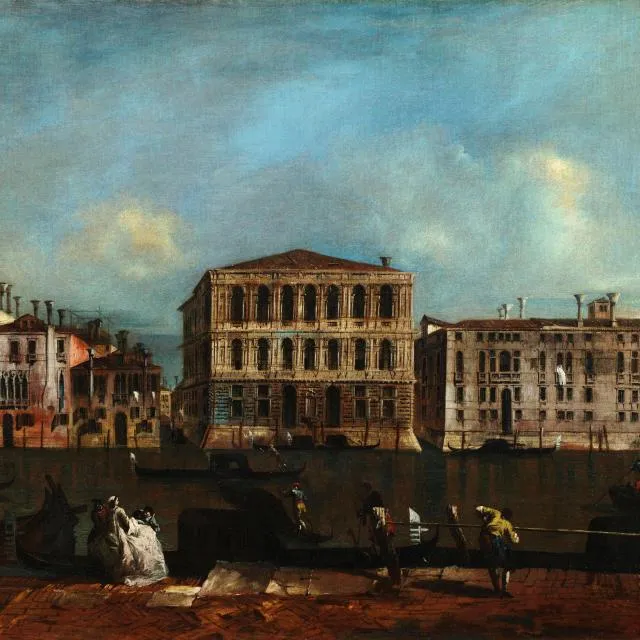
The Venetian Arsenal, a fortified shipyard and armoury, had been celebrated as a symbol of the Venetian Republic’s domination of the Mediterranean sea trade since the twelfth century. Here we see the main gateway, its classical columns and pediments decorated with statues of Greek and Roman gods, whose attributes are symbols of war, victory, justice and wealth. Standing guard is a majestic lion, the symbol of Saint Mark, patron saint of Venice. Other statues of lions crouch, appearing ready to pounce on intruders and saboteurs. The bronze flagstaff in the centre of the square was installed in 1693 to commemorate Doge Francesco Morosini’s naval victories against the Turkish empire from 1688 to 1694.High, heavily guarded walls once shielded the Arsenal from public view, but the open window to the left and people coming out of the gate suggest that the once formidable security has been relaxed. In its heyday the Arsenal was a powerful, self-contained community of shipbuilders and labourers; by the mid-eighteenth century, Venice was no longer such a great sea power, and shipbuilding was in a state of decline. Here, the Arsenal is depicted as part of a picturesque scene rather than a vital part of the economy, though during Guardi’s lifetime the city’s ports and harbours remained lively trading hubs. Venetians, tourists, seamen and traders gather in leisurely groups, but a hoisted bridge and large barge being pulled along the canal hint that everyday business continues.Painted in around 1755/60 as one of Guardi’s earliest views, this composition is based on etchings by his near contemporaries Luca Carlevarijs and Michele Marieschi. Guardi likely derived his composition for Venice: The Grand Canal with Palazzo Pesaro from a design by Marieschi, but the main source of inspiration for many of his paintings was Canaletto. Here, Guardi leaves us in no doubt as to who painted this work: his signature appears on a cartellino or scroll attached to the plinth below the main lion.
63 collected·47 zoomed·0 comments
About this artwork
Venice: The Arsenal (1755-60) by Francesco Guardi, oil on canvas, from the National Gallery, London collection.
About Francesco Guardi
Francesco Lazzaro Guardi (Italian pronunciation: [franˈtʃesko ˈgwardi]; 5 October 1712 – 1 January 1793) was an Italian painter, nobleman, and a member of the Venetian School. He is considered to be among the last practitioners, along with his brothers, of the classic Venetian school of painting.
More by Francesco Guardi
Comments (0)
No comments yet. Be the first to share your thoughts.