

Venice: The Doge's Palace and the Riva degli Schiavoni

late 1730s · Oil on canvas
Dimensions 61.3 x 99.8 cm
Collection: National Gallery, London
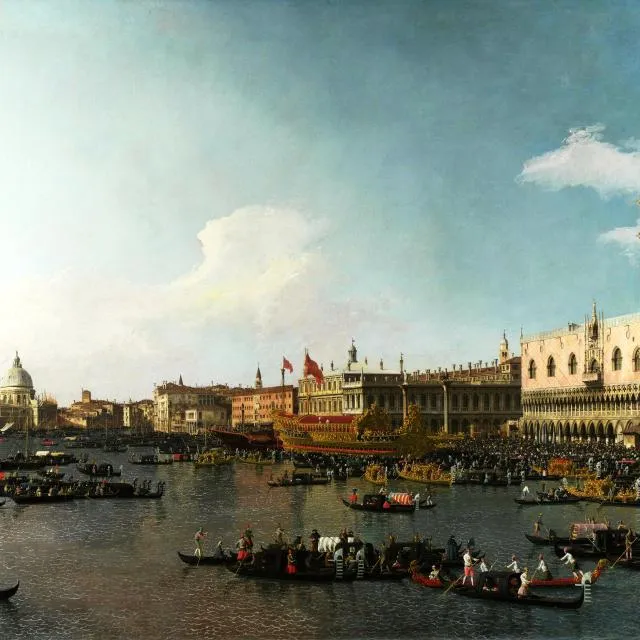
Beneath a sky of swirling cloud and warm sunlight, we take in a view of the Doge’s Palace, one of the best-known buildings in Venice. It overlooks a promenade called the Riva degli Schiavoni and the basin of San Marco. The Riva degli Schiavoni is named after the Slavic people from Dalmatia – present-day Croatia – who settled in this part of the city. Canaletto has given the scene a sense of tranquillity and calm.While Canaletto sometimes captured important ceremonies taking place along the waterfront – see The Basin of San Marco on Ascension Day, for example – his subject here is the city in a quieter moment. A group of idle sailors surround the column of San Marco; one of them, hands on his hips and stood beside a barrel, is eager to explore his new surroundings. Nearby, we see merchants and foreign visitors, perhaps recently arrived from ports around the Mediterranean or beyond. Just in front of us and to the right, several boatmen pause for a moment to look out over the lagoon.The churches and houses beyond the palace are laid out at a steeply receding angle, and the roof of the palace creates a line of glossary:perspective. Back on street level, this device leads our eye back towards the groups of Venetians on a leisurely walk, an old man with a walking stick and government officials in black robes, and then a knife-grinder beside a simple wooden hut. Precise brushstrokes describe the outfits and poses of the foreground figures. The palette is dominated by browns and blues, punctuated by the vivid red of hats and touches of yellow and white for the clothing.We are positioned just above the quayside so that the watercraft – sailing boats, barges, gondolas, galleys, and the fusta (single-masted boat) covered in a red and gold striped awning – fill the right-hand side of the composition; the water is barely visible. From up close, the varied brushwork becomes apparent that Canaletto used to describe different textures and materials, particularly the splintered and broken timbers and pieces of stone littering the water’s edge. Thick layers of paint (impasto) combined with areas of thinner, almost transparent, paint create the white sail on the right, capturing the form of the cloth and the effects of light on it.Here, Canaletto paints one of Venice’s most iconic waterfront vistas. He repeatedly used ordinary Venetians and parts of the city that were popular among tourists as inspiration. They were also painted by Canaletto’s contemporaries, among them his nephew and talented pupil Bernardo Bellotto, and later in the century by Francesco Guardi.
155 collected·182 zoomed·0 comments
About this artwork
Venice: The Doge's Palace and the Riva degli Schiavoni (late 1730s) by Canaletto, oil on canvas, from the National Gallery, London collection.
About Canaletto
Giovanni Antonio Canal (18 October 1697 – 19 April 1768), commonly known as Canaletto (Italian: [kanaˈletto]), was an Italian painter of city views or vedute, of Venice, Rome, and London.
More by Canaletto
Comments (0)
No comments yet. Be the first to share your thoughts.