

Venice: The Feast Day of Saint Roch

about 1735 · Oil on canvas
Dimensions 147.7 x 199.4 cm
Collection: National Gallery, London
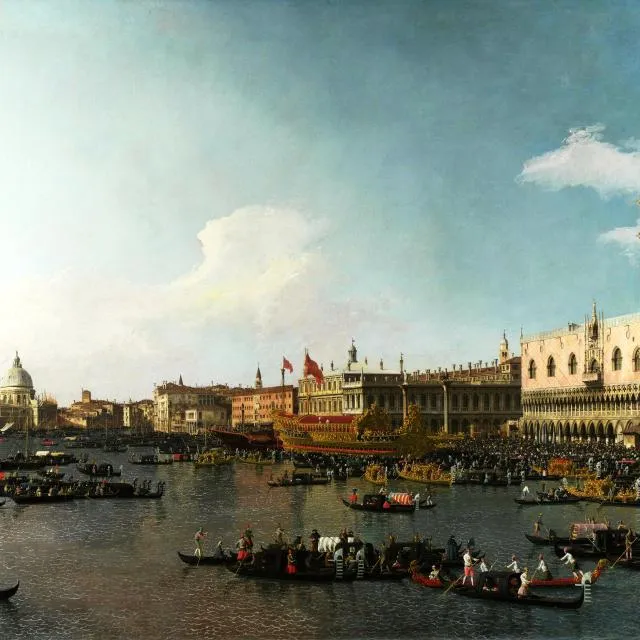
Richly dressed state dignitaries and foreign ambassadors emerge from a church on the right side of this painting. A mass of people have gathered to watch the grand procession; most of them have their backs to us, giving the impression that we too are part of the crowd, stood just behind them. We are witnessing the feast day of Saint Roch, held every year on 16 August to celebrate his role in bringing the plague of 1576 to an end.On this day it was customary for the doge of Venice to attend mass in the church of San Rocco, where the saint’s relics were revered. The men in the procession all carry nosegays, a sweet-scented bunch of flowers originally intended to mask unpleasant smells, as a memorial to the plague. Canaletto has used energetic brushwork and thick accents of paint to describe their hair and their ceremonial robes. The doge himself is dressed in a golden, ermine-lined ceremonial robe, a cap and rensa (a white linen head-cloth); we think this painting was made in around 1735, which means that he could be the newly elected Doge Alvise Pisani. To his left is the French ambassador, and to his right, a representative of the papal embassy, wearing a black cape with a hood (known as a mozzetta). In front of them are the scarlet-clad grand chancellor, two servants who carry an upholstered chair and a cushion, and three secretaries in purple garments. A canvas awning above the group provides shade, and its horizontal line creates an undulating rhythm across the lower composition that accentuates the movement of the procession.Sunlight catches faces in the crowd and those in the procession at different angles. Canaletto developed a particular way of painting large numbers of faces – he used highlights on the forehead and cheeks to show how each head was angled in relation to the light, with dots for the eyes, chin and nose. Some figures have individual characteristics, like those at the head of the procession, the two men walking towards us on the far left or the man standing opposite a vendor with weighing scales, his face in full sunlight. Even those facing away from us have personality, expressed through pose and outfit. In the foreground, we see a beggar in a ragged brown cloak accompanied by a small boy who bends over, possibly thinking about picking a pocket. Nearby, two visitors from the Near East stand in white robes, alongside baskets of vegetables that have been temporarily abandoned as the procession passes.This view reveals Canaletto’s inventiveness – he has greatly enlarged the square to accommodate the sizeable crowd and removed buildings from one side to give us a clear view of the scene. If we compare the scale of the men in the procession with that of onlookers standing in the two doorways behind, we can see how he has used the relative size of figures to give the painting a greater sense of spatial depth. The spectacular facade of the Scuola Grande di San Rocco, built to house one of Venice’s most important religious and charitable organisations, dominates the background. Canaletto’s brushstrokes mimic the materials that they represent in the Scuola’s stonework, coloured marble inlays and sculpted columns. Work started on the building’s construction in 1517 with the facade we see here, which was designed by the Italian architect Antonio Scarpagnino in 1527.During the feast day the doge and his guests were shown the great works of Tintoretto inside the Scuola, which remain there today. An exhibition of paintings by old and contemporary masters was traditionally held outside the Scuola. Here, religious and historical subjects, portraits and view paintings are hung on the facade and on the houses to the left, attracting the attention of passersby. These paintings were lent by artists and collectors, some eager to find buyers. Giovanni Battista Tiepolo, Sebastiano Ricci and Bellotto displayed their own works on such occasions. We know that Canaletto exhibited a view of the Venetian church of Santi Giovanni e Paolo in 1725, which was bought by an ambassador who attended the procession. There have been attempts to identify the pictures displayed here: the canvas on the far right resembles a view of the Grand Canal by Canaletto and the painting to the left of the largest one looks like an altarpiece by Johann Liss.Canaletto only painted the doge’s visit to San Rocco once, though he depicted other Venetian ceremonies numerous times, such as those in A Regatta on the Grand Canal and The Basin of San Marco on Ascension Day. We know very little about this painting’s early history apart from an intriguing reference to it in a sale catalogue of 1802 which states that it came ‘from the Vatican’, though this may be inaccurate.
95 collected·97 zoomed·0 comments
About this artwork
Venice: The Feast Day of Saint Roch (about 1735) by Canaletto, oil on canvas, from the National Gallery, London collection.
About Canaletto
Giovanni Antonio Canal (18 October 1697 – 19 April 1768), commonly known as Canaletto (Italian: [kanaˈletto]), was an Italian painter of city views or vedute, of Venice, Rome, and London.
More by Canaletto
Comments (0)
No comments yet. Be the first to share your thoughts.