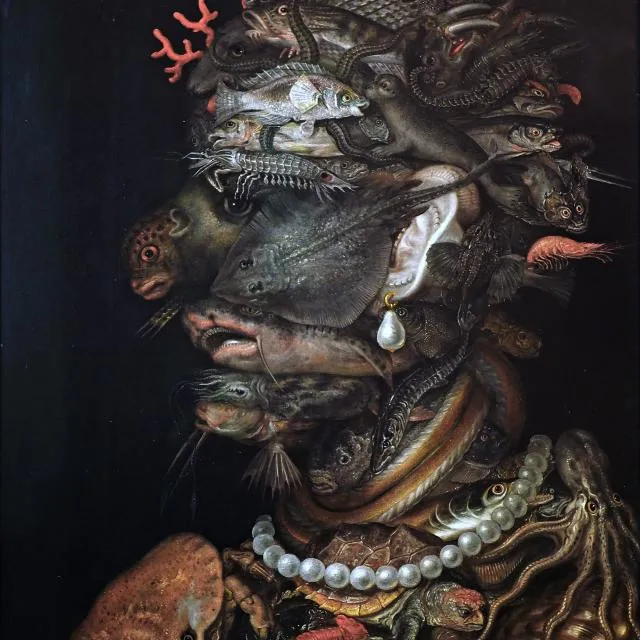
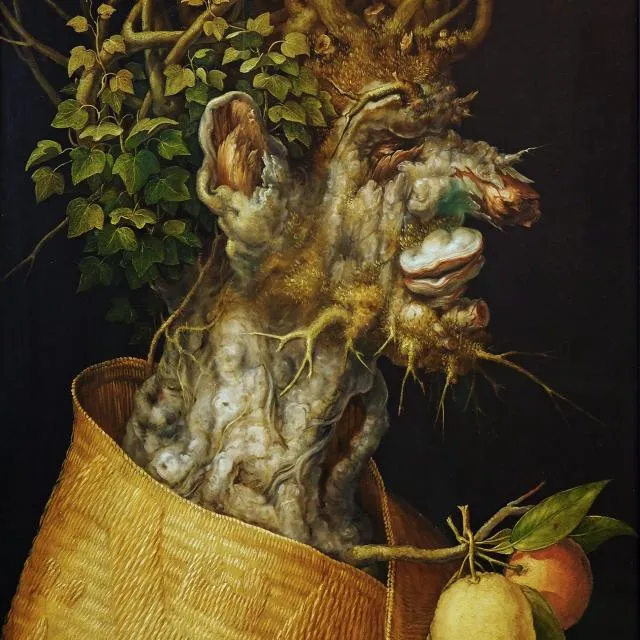
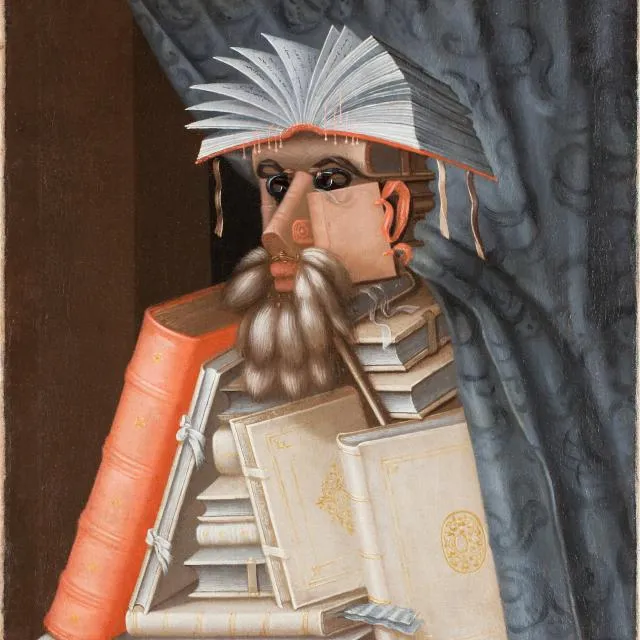
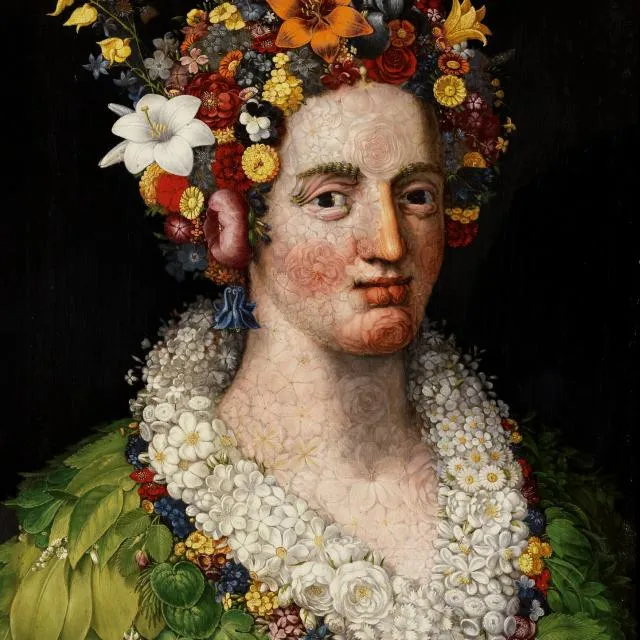
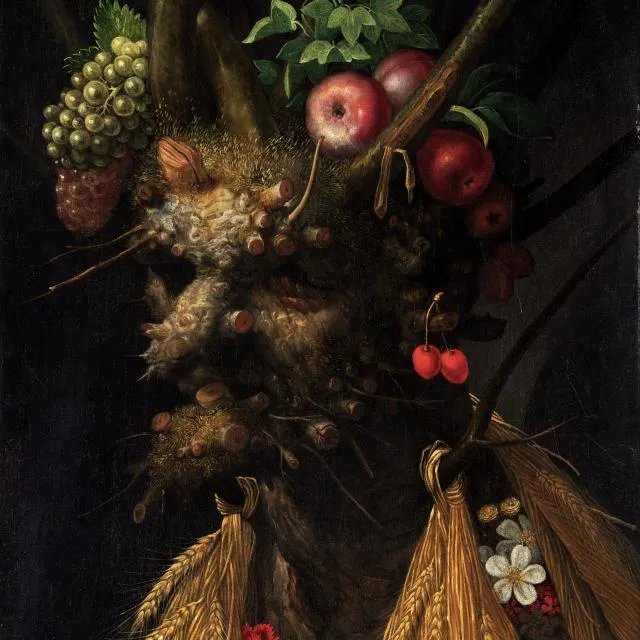
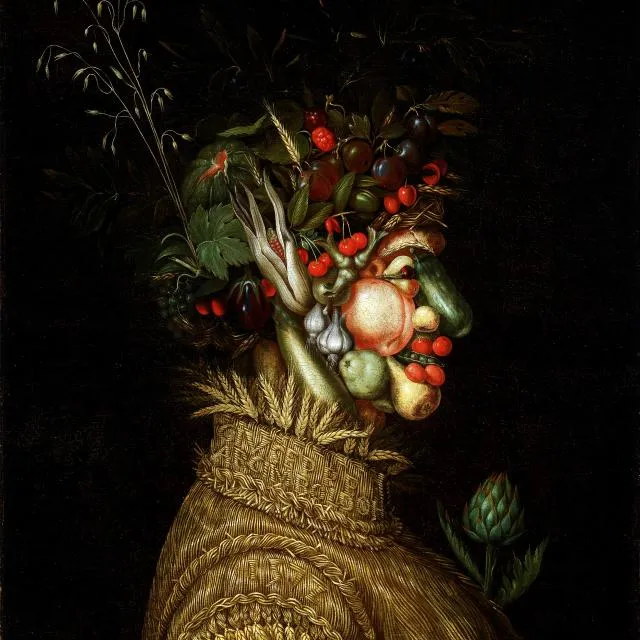
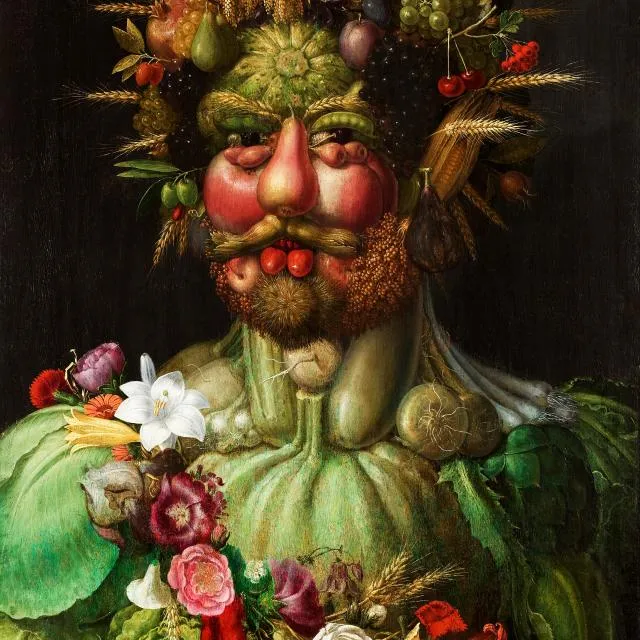
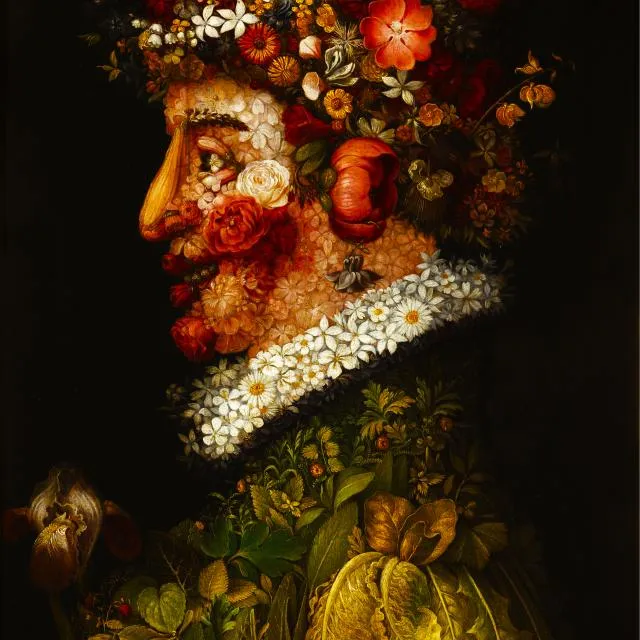
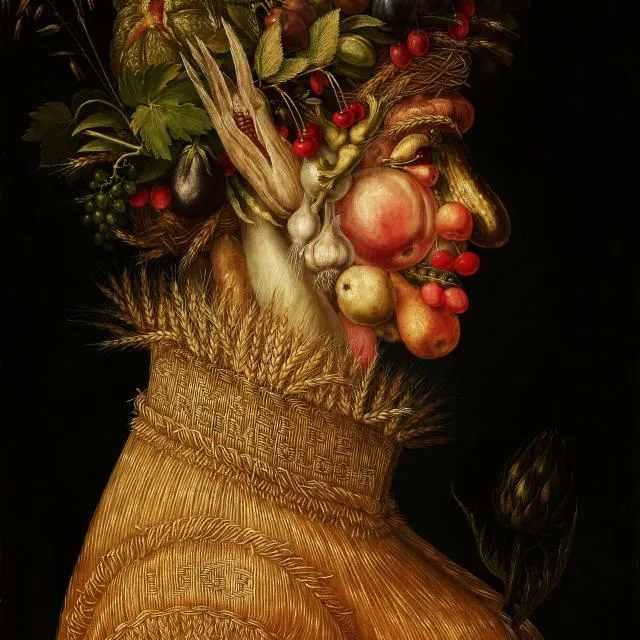
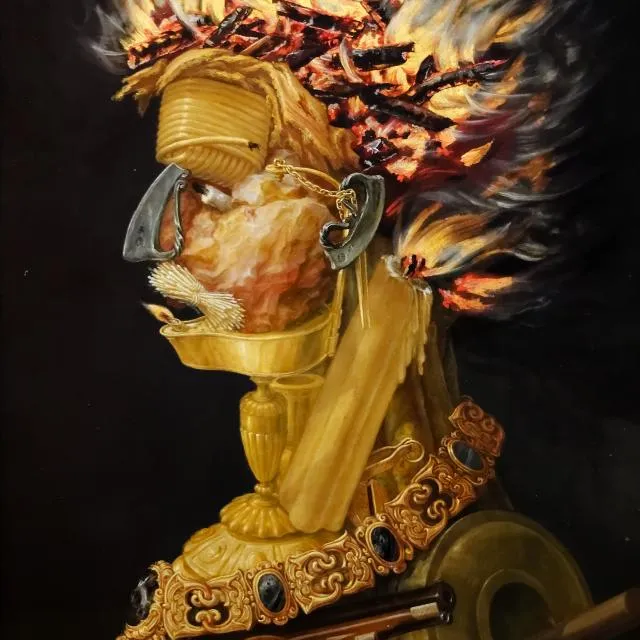
Giuseppe Arcimboldo; also spelled Arcimboldi (1526 or 1527 – 11 July 1593) was an Italian painter best known for creating imaginative portrait heads made entirely of objects such as fruits, vegetables, flowers, fish and books.
These works form a distinct category from his other productions. He was a conventional court painter of portraits for three Holy Roman Emperors in Vienna and Prague, also producing religious subjects and, among other things, a series of coloured drawings of exotic animals in the imperial menagerie. The still-life portraits were clearly partly intended as whimsical curiosities to amuse the court, but critics have speculated as the degree of serious engagement with Renaissance Neo-Platonism or other intellectual currents that they have.
Giuseppe's father, Biagio Arcimboldo, was an artist of Milan. Like his father, Giuseppe Arcimboldo started his career as a designer for stained glass and frescoes at local cathedrals when he was 21 years old.
In 1562, he became court portraitist to Ferdinand I at the Habsburg court in Vienna, Austria and later, to Maximilian II and his son Rudolf II at the court in Prague. He was also the court decorator and costume designer.
Arcimboldo's conventional work, on traditional religious subjects, has fallen into oblivion, but his portraits of human heads made up of vegetables, plants, fruits, sea creatures and tree roots, were greatly admired by his contemporaries and remain a source of fascination today.
At a distance, his portraits looked like normal human portraits. However, individual objects in each portrait were actually overlapped together to make various anatomical shapes of a human. They were carefully constructed by his imagination. The assembled objects in each portrait were not random: each was related by characterization. By using everyday objects, the portraits were decoration and still-life paintings at the same time.His works showed not only nature and human beings, but also how closely they were related.
Art critics debate whether his paintings were whimsical or the product of a deranged mind. A majority of scholars hold to the view, however, that given the Renaissance fascination with riddles, puzzles, and the bizarre, Arcimboldo, far from being mentally imbalanced, catered to the taste of his times.
Arcimboldo died in Milan, where he had retired after leaving the Prague service. It was during this last phase of his career that he produced the composite portrait of Rudolph II, as well as his self-portrait as the Four Seasons. His Italian contemporaries honored him with poetry and manuscripts celebrating his illustrious career.
When the Swedish army invaded Prague in 1648, during the Thirty Years' War, many of Arcimboldo's paintings were taken from Rudolf II's collection.
His works can be found in Vienna's Kunsthistorisches Museum and the Habsburg Schloss Ambras in Innsbruck; the Louvre in Paris; as well as in numerous museums in Sweden. In Italy, his work is in Cremona, Brescia, and the Uffizi Gallery in Florence. The Wadsworth Atheneum in Hartford, Connecticut; the Denver Art Museum in Denver, Colorado; the Menil Foundation in Houston, Texas; the Candie Museum in Guernsey and the Real Academia de Bellas Artes de San Fernando in Madrid also own paintings by Arcimboldo.
While Arcimboldo has largely slipped through the cracks of time without the notoriety of some of his contemporaries there has been renewed interest his work after the start of the surrealist movement.