

Christ after the Flagellation contemplated by the Christian Soul
probably 1628-9 · Oil on canvas
Dimensions 165.1 x 206.4 cm
Collection: National Gallery, London
Tied to a column, Christ has collapsed to the floor, a noose hanging around his neck. His limp body, tilted head and pained expression show his exhaustion and suffering. We see the moment after the Flagellation, when Christ was flogged by Roman soldiers – the sticks and whip they used to beat him lie in the foreground.The brutality of this assault is implied by spots and trickles of blood on Christ’s body and the column, the worst being hidden in the shadows and on the frayed rope and broken twigs. The plain space and deep shadow draw our attention towards Christ, whose head lies at the centre of two diagonals, at the very heart of this composition.It’s an unusual focus: paintings often show Christ being beaten by his tormentors rather than the moment after they leave. Here Christ is accompanied by a young boy representing the Christian Soul with its Guardian Angel. The angel leans over and gently directs the boy to consider the suffering of Christ; he kneels, with his hands clasped in prayer, and gazes at him with a sorrowful expression. As Christ looks towards the boy, a ray of light radiates from his head, towards the boy’s heart. The combination of Christ, the angel and the Soul is rarely seen in paintings, though a few examples can be found by seventeenth-century artists working in Seville, where Velázquez spent his early career.In religious paintings such as Kitchen Scene with Christ in the House of Martha and Mary, Velázquez combines the everyday with a scene from the Bible. Here the subject is religious and, although Christ is accompanied by allegorical figures, they all seem so lifelike and human, their emotions heartfelt.During the Catholic Reformation, images of Christ tied to the column became objects of devotion, either intended for a chapel or for private contemplation. The Church taught that meditation on the Passion was necessary for salvation; worshippers were encouraged to imagine that they were present at events leading up to the Crucifixion.Velázquez was appointed court painter in 1623, after which he made very few religious works, his time being mostly taken up with painting portraits of the royal household. This painting was probably made around 1628–9, just before Velázquez’s first trip to Italy between 1629 and 1630, but it has also been dated to his Italian stay and to the period immediately following, once he had returned to Madrid. The fact that it is painted on the reddish-brown ground typical of Velázquez before his trip to Italy, suggests a date before 1629.
102 collected·143 zoomed·0 comments
About this artwork
Christ after the Flagellation contemplated by the Christian Soul (probably 1628-9) by Diego Velazquez, oil on canvas, from the National Gallery, London collection.
About Diego Velazquez
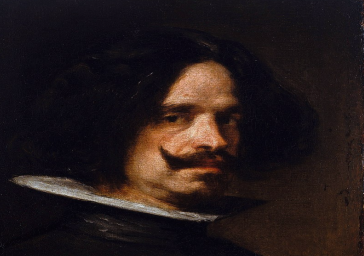
(baptized June 6, 1599 – August 6, 1660) Diego Rodríguez de Silva y Velázquez was a Spanish painter, the leading artist in the court of King Philip IV, and one of the most important painters of the Spanish Golden Age. He was an individualistic artist of the contemporary Baroque period.
More by Diego Velazquez
Comments (0)
No comments yet. Be the first to share your thoughts.