

The Building of the Trojan Horse

about 1760 · Oil on canvas
Dimensions 38.8 x 66.7 cm
Collection: National Gallery, London
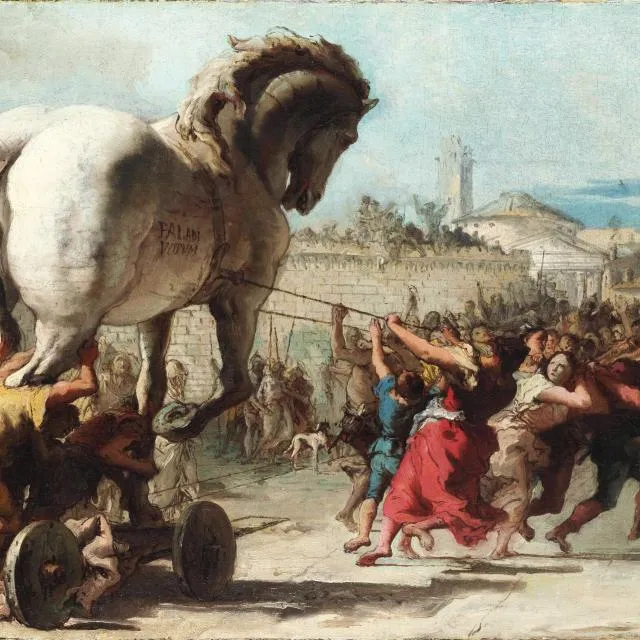
The Building of the Trojan Horse illustrates an episode from one of the most famous stories in Greek mythology – that of the Trojan War. It shows workmen building the giant wooden horse in which Greek soldiers will hide, allowing them to secretly enter Troy. The city’s battlements loom above them, rooftops and a slender spire just visible beyond.Giovanni Domenico Tiepolo has described the final stages of the horse’s construction in great detail. The composition incorporates a remarkable amount of activity: men with hammers and chisels labour tirelessly, balancing on scaffolding and ladders or gathering on the ground, giving us a real sense of the urgency of their work. One of them sits on a plank and raises a brush to paint the horse’s rump, as though it’s a blank canvas primed for painting. The glossy coat, powerful pose and flowing mane of the horse give the impression that it is alive and moving. Domenico has painted it in a sharply foreshortened pose and it faces away from us, with most of the body in shadow and the rump bathed in strong sunlight. On the far right, several solders in armour prepare for battle. The two figures on the left could be the Greek heroes Odysseus and Agamemnon, although one of them might in fact be Epeius, the builder of the horse, directing operations. In the distance, women and children watch intently.This painting is probably a sketch for Domenico’s monumental picture of the same subject, painted in around 1773/4, now in the Wadsworth Atheneum in Hartford, Connecticut. It has characteristics of a preparatory design. It is a small-scale work with loosely applied paint, and Domenico was working out ideas as he went along, for example, making slight changes to the positions of some of the workers. The whole scene was thinly painted, adding to the spontaneity of the technique. He made the outlines of the central figures clustering round the horse with the very tip of a small brush, and combined rich yet subtle tones: pale pink and blue contrast with brilliant crimsons, yellows and greens.Domenico also painted The Procession of the Trojan Horse, which depicts the Trojans wheeling the horse inside the city walls, believing it to be a gift from the gods. He spent much of his career working alongside his father, Giovanni Battista, in Venetian palaces and churches, adopting his distinctive drawing style and colouring. In fact, on entering the National Gallery’s collection, The Building of the Trojan Horse and The Procession of the Trojan Horse were attributed to Giovanni Battista, but they must be the work of Domenico as the larger paintings were made after his father’s death.
68 collected·50 zoomed·0 comments
About this artwork
The Building of the Trojan Horse (about 1760) by Giovanni Domenico Tiepolo, oil on canvas, from the National Gallery, London collection.
More by Giovanni Domenico Tiepolo
Comments (0)
No comments yet. Be the first to share your thoughts.