

The Procession of the Trojan Horse into Troy

about 1760 · Oil on canvas
Dimensions 38.8 x 66.7 cm
Collection: National Gallery, London
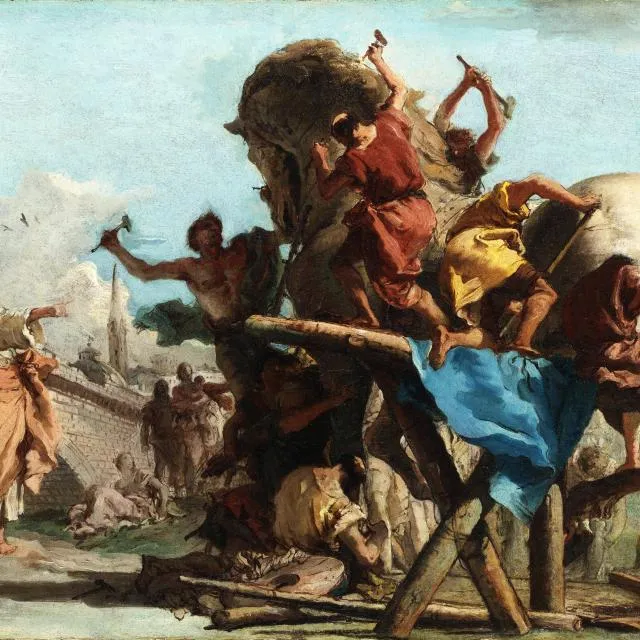
This painting shows an episode from the mythological Trojan War, as described by the Roman poet Virgil in the Aeneid. The Trojans rejoice as they pull a large wooden horse into their city, believing it to be a gift from the gods. An inscription in Latin on the horse’s side reads ‘PALADI VOTUM’ (An offering to Pallas). This was another name for the Greek goddess Athena, famed for her wisdom, courage and strength in warfare.The horse actually conceals a band of Greek soldiers, waiting to attack. In the centre background, we see the arrest of Cassandra, daughter of the King of Troy, who had prophesied disaster if the horse entered the city. She was declared mad but turned out to be correct: once inside Troy, the Greeks took control the city.This sketch conveys something of the story’s epic nature in the feverish activity of the crowd and the horse’s looming stature. As in The Building of the Trojan Horse, Domenico has ignored the fact that the horse was a piece of sculpture and modelled it to look like a flesh-and-blood animal, with a close study of its muscular body and the texture of its mane and tail. Here, the pose emphasises the direction in which the row of men are pushing the horse. Another group use all their strength to tug on ropes attached to the horse’s sides; one young boy is not quite tall enough to help. The high walls, upon which people gather to catch a glimpse of what’s going on, and the sharply receding space lead our eye towards the distant city, which is made up of buildings of different heights and styles. The view of Troy is based closely on ancient buildings in Rome, and the gigantic battlements recall ancient fortifications.This scene and The Building of the Trojan Horse were intended as oil sketches for much larger paintings. As a preliminary design, Domenico sketched in the outlines of the figures rapidly and then brushed in colour to give a three-dimensional appearance. The colour is rather muted, with ochre, beige and greys, and the only strong colour accent is the woman’s red dress at the centre. We know that Domenico painted the monumental pictures in around 1773/4, but the location of the work that relates to this sketch is unknown. The final painting of The Building of the Trojan Horse is now in the Wadsworth Atheneum in in Hartford, Connecticut.
113 collected·157 zoomed·0 comments
About this artwork
The Procession of the Trojan Horse into Troy (about 1760) by Giovanni Domenico Tiepolo, oil on canvas, from the National Gallery, London collection.
More by Giovanni Domenico Tiepolo
Comments (0)
No comments yet. Be the first to share your thoughts.