

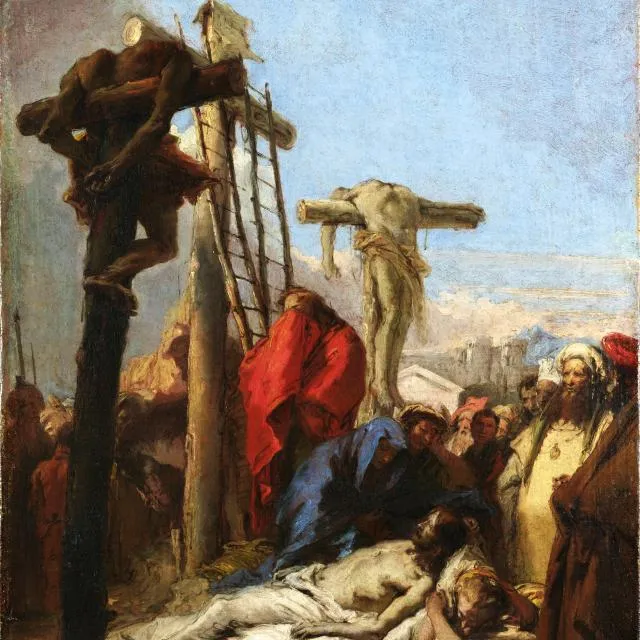
The Lamentation at the Foot of the Cross

probably 1750-60 · Oil on canvas
Dimensions 80 x 89.2 cm
Collection: National Gallery, London
Christ’s lifeless body, supported by the Virgin Mary, lies at its foot of the Cross. The Virgin gazes towards heaven in deep sorrow, her brow furrowed. A fair-haired Saint Mary Magdalene clings to Christ’s left arm, unable to contain her grief. In the centre, Saint John the Evangelist buries his face in his red drapery, while other mourning figures stand around him. In the background is the city of Jerusalem.This episode isn‘t actually described in the Bible, but there was a long tradition of illustrating it. Rather than concentrating exclusively on the lamentation over Christ’s body, Giovanni Domenico Tiepolo has included other elements from the story of the Passion. Here we see the two thieves who were crucified alongside Christ, as well as ladders propped against the Cross, elements which usually appear in pictures of the Crucifixion and the Deposition. On the right is the ’good thief‘, who recognised Christ as the son of God and was saved; the ’bad thief', who was damned, has his back to us. Their bodies are not nailed to their crosses, but tied backwards over the cross bar: this may be closer to reality. The two turbaned men on the right may be Joseph of Arimathea and Nicodemus, who anointed and buried Christ’s body (John 19: 39). If so, it would point forward to the next event of the Passion: the Entombment.The crosses are set well above the crowd, against the blue and beige sky. They are potent and moving symbols, but their placing also creates depth and their outlines give subtle movement against the background. In both the crucified bodies and the main foreground figures, Domenico focused on body language rather than facial expressions – the Virgin being the exception – as a way of provoking feelings of pity and sadness in the viewer.Domenico was much influenced by Rembrandt. Joseph Smith, British consul in Venice and an enthusiastic art collector, owned Rembrandt’s The Lamentation over the Dead Christ. Domenico could have seen it in the 1730s, when he painted this work, or else he knew an etching after it. His picture owes a great debt to Rembrandt, whose influence can be seen in the bearded men, a facial type that we know Rembrandt studied closely and included in numerous religious paintings.There is another version of the Lamentation by Domenico in the National Gallery’s collection – it is smaller in size and painted in an upright format, and is even more closely related to Rembrandt’s work. Domenico painted these two works in different ways: this one has a more finished appearance, and the clothing, the faces and the town in the background are described in greater detail. These works may have been part of a series by Domenico that explores the themes of the Passion.
57 collected·42 zoomed·0 comments
About this artwork
The Lamentation at the Foot of the Cross (probably 1750-60) by Giovanni Domenico Tiepolo, oil on canvas, from the National Gallery, London collection.
More by Giovanni Domenico Tiepolo
Comments (0)
No comments yet. Be the first to share your thoughts.