

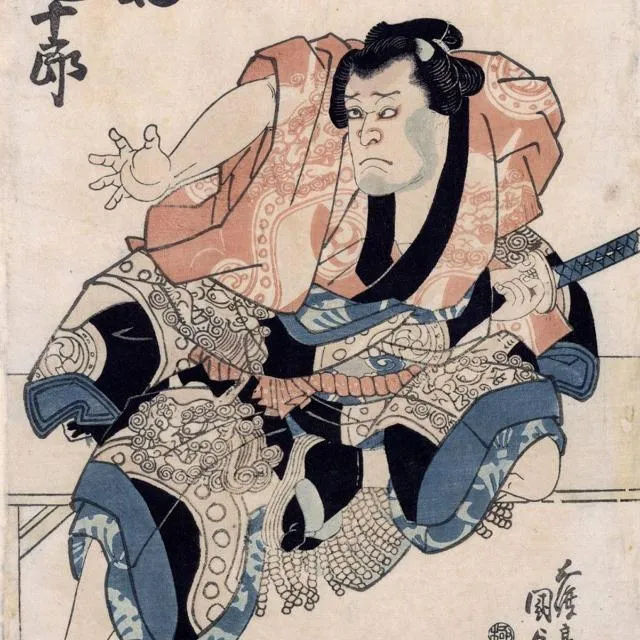
Nakamura Shikan as Takahashi Sakujuro (中村芝翫 髙橋作十郎)

1832 · Nishiki-e (錦絵, Woodblock print ink and color on paper)
Dimensions 36.8 × 24.3 cm
Collection: Central Saint Martins Museum & Study Collection: Japanese Actor Prints
This image is from Tsuru Hitosuji Kaga no Bundai(蔓一筋加賀文台), a popular kabuki in the early 18th century. The story focuses on a female called Tsuru who falls in love with a male called Kaga, despite his family's disapproval so she disguises herself as a male to get close to Kaga. In kabuki, female roles are usually played by male, so it would be more challenging for actors as there are multiple twists on the gender in this play. This character, Takahashi Sakujuro(髙橋作十郎) is looking down at a letter he is burning over a brazier. Washi was further developed by Japanese craftsmen by adding fibres from the inner bark of the gampi tree, the mitsumata shrub (三椏, edgeworthia chrysantha), or kōzo (楮, the mulberry) bush giving the paper enough durability to be printed on several times without degradation. The importance of washi within Japanese culture further emphasises the act of burning a letter within the print.
34 collected·37 zoomed·0 comments
About this artwork
Nakamura Shikan as Takahashi Sakujuro (中村芝翫 髙橋作十郎) (1832) by Utagawa Kunisada (歌川国貞), Nishiki-e (錦絵, Woodblock print ink and color on paper), from the Central Saint Martins Museum & Study Collection: Japanese Actor Prints collection.
About Utagawa Kunisada (歌川国貞)
Utagawa Kunisada (1786 – 12 January 1865), also known as Utagawa Toyokuni III (三代 歌川 豊国 Sandai Utagawa Toyokuni), was the most popular, prolific and commercially successful designer of ukiyo-e woodblock prints in 19th-century Japan.
More by Utagawa Kunisada (歌川国貞)
Comments (0)
No comments yet. Be the first to share your thoughts.